stackgrad Showcase¤
Things stackgrad runs. Every number below comes from a file the named script writes, in bench/results/ or runs/.
Qwen3-0.6B chat¤
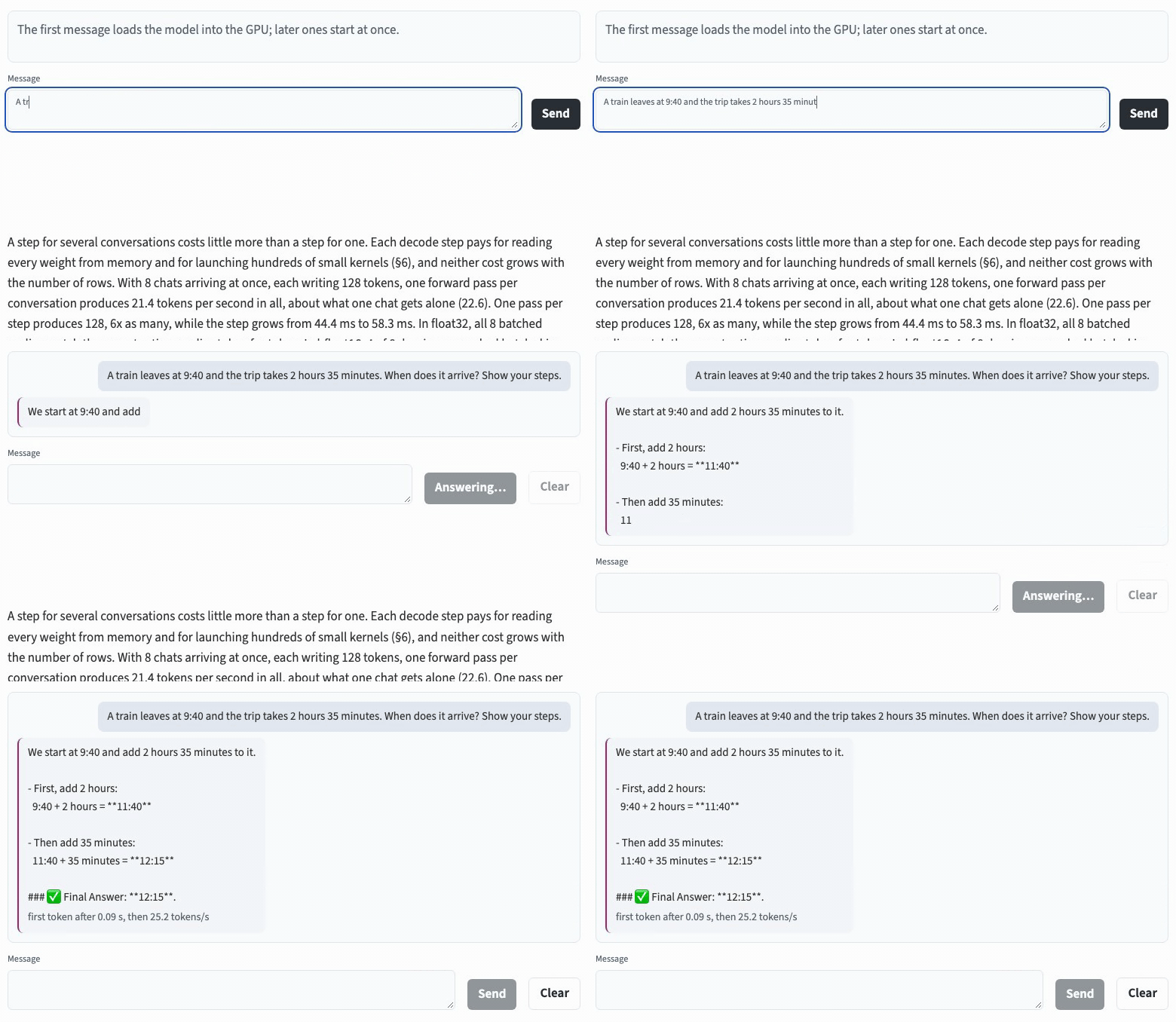
Qwen3-0.6B on stackgrad's own engine and server on an M4, recorded in real time: the first token after 0.09 s, then 25.2
tokens per second. Its logits match Hugging Face's to 5.1e-5 in float32, and greedy decoding reproduces its first 24
tokens (tests/qwen3.py). Eight chats at once decode 128.4 tokens per second in total, 6.0x one forward pass per chat
(bench/serve_batch.py).
uv sync --extra metal --extra serve
uv run hf download Qwen/Qwen3-0.6B --local-dir data/Qwen3-0.6B
uv run uvicorn stackgrad.serve.api:app --port 8000
curl localhost:8000/v1/chat/completions -H 'Content-Type: application/json' \
  -d '{"messages": [{"role": "user", "content": "What is 17 times 23? Answer briefly."}], "temperature": 0}'
Training a language model¤
A 22.7M-parameter model trains on TinyStories (327.7M tokens) to a validation loss of 1.399 in 71 minutes on one RTX 3090, at 23.9% MFU.
uv run python scripts/tinystories.py download   # then: train, encode
CUPY_TF32=1 uv run --no-dev python train_gpt.py --run tinystories --device cuda
Training beside PyTorch¤
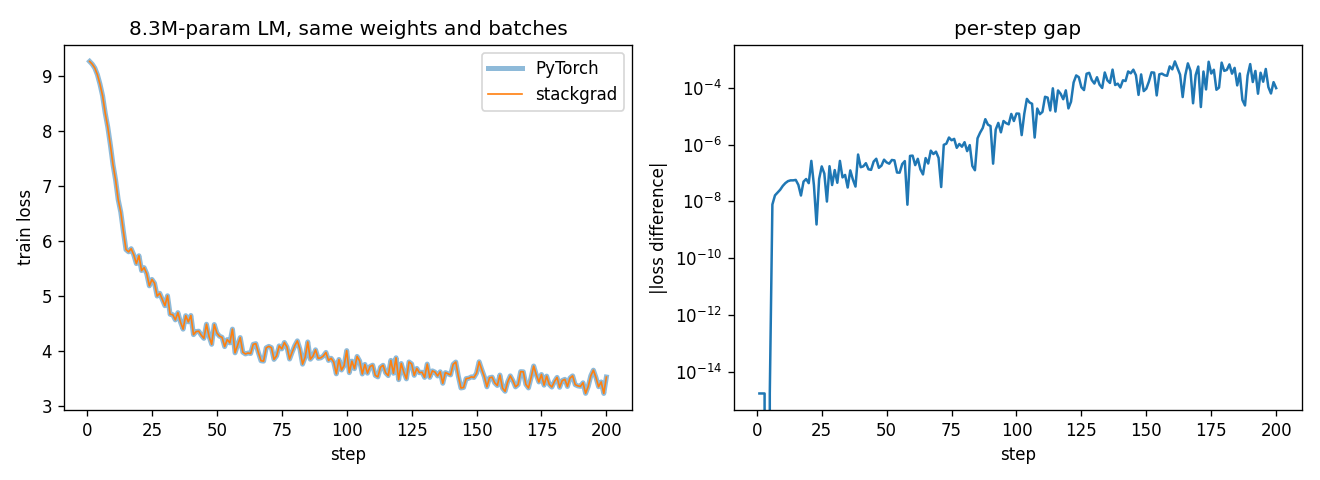
stackgrad and PyTorch train the same 8.3M-parameter model from the same weights on the same batches, in float64. At step 1 their losses differ by 1.8e-15.
uv run python bench/m1_parity.py --float64
Stable Diffusion¤

Stable Diffusion v1.5 in one file, like tinygrad's: CLIP's text encoder, the UNet stepping through DDIM, and the VAE
decoder. tests/stable_diffusion.py checks each network against diffusers.
uv run python -c 'from huggingface_hub import snapshot_download; snapshot_download("stable-diffusion-v1-5/stable-diffusion-v1-5", local_dir="data/sd15", allow_patterns=["tokenizer/*", "scheduler/*", "*/config.json", "*/*.fp16.safetensors"])'
uv run python examples/stable_diffusion.py --device metal --prompt "a watercolor of a lighthouse at dusk"
GPT-2¤
OpenAI's 124M-parameter model, one file. tests/gpt2.py checks it against transformers.
uv run python -c 'from huggingface_hub import snapshot_download; snapshot_download("openai-community/gpt2", local_dir="data/gpt2")'
uv run python examples/gpt2.py --device metal --prompt "The meaning of life is"
Retrieval and an agent¤
With the server running, Qwen3-Embedding-0.6B on stackgrad finds the SQuAD v1.1 paragraph a question came from among
its top three 91.5% of the time, and 55% of answers then contain the reference (apps/rag.py). apps/agent.py gives
the model a calculator tool for GSM8K.
Attention kernels¤
At the training shape, where each head is 32 numbers wide and MLX has no fused kernel, the Metal attention kernel runs
6.7x faster than MLX. At Qwen3's 128-wide heads, MLX's fused kernel runs 2.6x faster than stackgrad's
(bench/flash_attention.py). FlashAttention-2 in Triton runs forward and backward 8.5x faster than the composed version
on the RTX 3090 (bench/flash_attention_cuda.py).
What did not work¤
On 250 GSM8K problems (greedy, thinking off, 320 new tokens), the released model solves 152.
| Attempt | Solved | Paired sign test |
|---|---|---|
| LoRA fine-tuning on GSM8K's solutions | 123 | p = 0.0011 |
| GRPO, reward requiring a finished reply | 139 | p = 0.13 |
| A calculator tool, asked for in the prompt | 42 | p < 0.0001 |
(bench/gsm8k.py, bench/gsm8k_compare.py)